


In June 2026, researchers and practitioners gathered at Eurac Research in Bolzano for the Futures Summit South Tyrol 2026 to examine how futures get captured, how we can actively expand them, and how critical long-term thinking can be embedded directly into governance and public policy. A fireside chat on “New futures paths, global-local transformations and regional perspectives” at Castel Flavon/Haselburg took these questions from global macro-trends down to regional action. Here are some of the insights it produced.
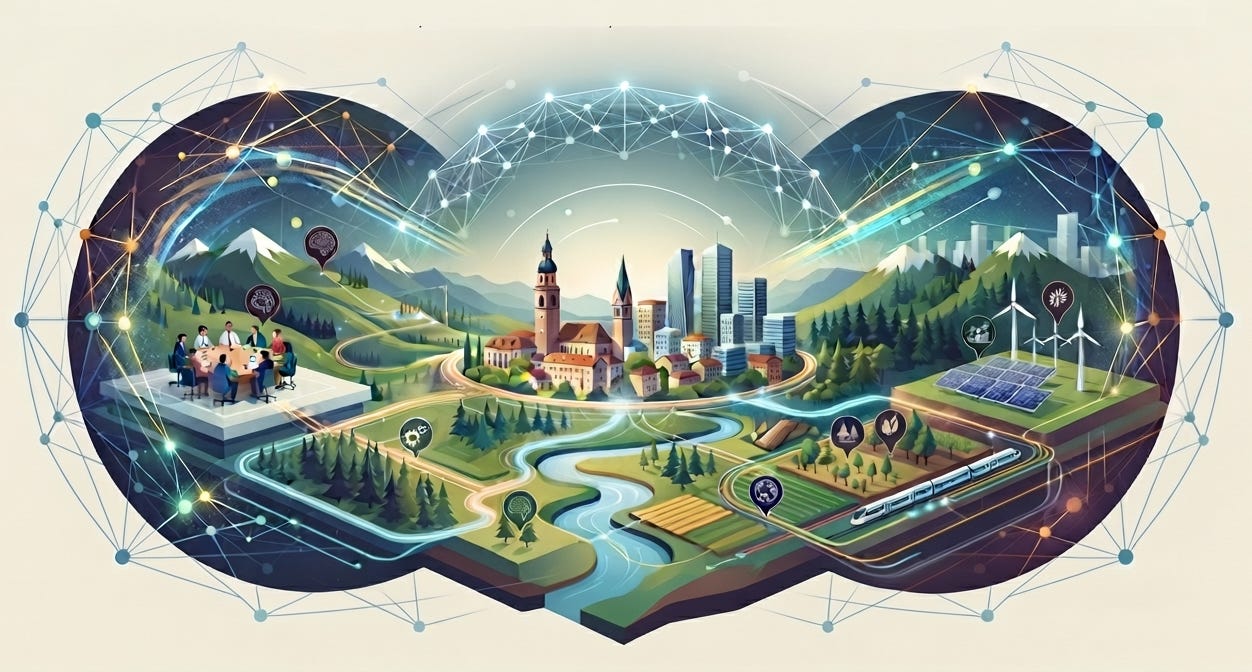
Does the future feel different today than it did ten years ago?
We live in a time when so many things are changing simultaneously that uncertainty and acceleration combine into a gigantic paradigm shift – or better, a paradigm opening.
The State of the Future Index (SOFI) by The Millennium Project, which combines historical data and expert opinions on fifteen global challenges, offers one way to take stock. For the 2035 horizon, it shows clear wins: R&D expenditure as a share of GDP has moved back into the winning column after being registered as losing in SOFI 2025, and progress continues in Internet access, renewable energy, school enrolment and health expenditure. Conversely, we are losing ground on civil liberties and institutional stability. Most alarmingly, the number of countries rated as free has moved into the losing column – adding to the historical core of losses such as wars and serious conflicts, terrorism, and the growth of the global refugee population.
The simultaneity of these advances and regressions shows that older frameworks are becoming insufficient. Ten years ago, dominant institutional frameworks still imagined “the future” as something relatively linear: more technology, deeper globalization, and continuous economic growth. Hartmut Rosa’s theory of social acceleration helps explain how technological change, social change and the pace of life reinforce one another. But humanity has experienced acceleration before. What makes our era distinct is the simultaneity and deep interdependence of transformations – technology, climate instability, geopolitical fragmentation, demographic shifts, Artificial Intelligence (AI), financial restructuring and changing cultural narratives all interact, so that linear assumptions no longer work. We live in a liminal age: the old order has been shaken, but a new one is not yet in sight. Perhaps this is why the future feels more open, but also more uncertain.
What has changed is not only the speed of change, but the nature of uncertainty itself: from prediction to permanent adaptation, from stable systems to cascading disruptions, from a single future to plural futures – which is why the language itself is shifting from “the future” to “futures“. Participants in World Futures Day 2026, a 24-hour global dialogue hosted every year on March 1st, saw it the same way: growing complexity produces multiple, overlapping futures rather than a single trajectory. Futures thinking can help avoid what Alvin Toffler called “future shock“ – the paralysis that occurs when change outpaces our capacity to process it. The question is no longer whether transformation is coming, but what kind of alternative futures our institutions and collective imagination are preparing us for.
Overall, compared with ten years ago, the future may appear more “colonized.” This is not merely a perception: the concentration of wealth in the hands of the world’s richest individuals – the so-called tech billionaires – has accelerated further since 2020, with nearly two-thirds of the wealth generated worldwide over the past five years going to the richest 1%. New philosophies of the future, such as longtermism, have emerged and gained traction, offering a justification for this inequality and promoting a vision of humanity’s long-term future whose supposedly inevitable outcome is our hybridization with machines and the emergence of a new superintelligent species.
These increasingly influential technological “hyperstitions” are shaping the course of the race for AI, the other major development of this decade. This race, in turn, has strengthened faith in techno-solutionism: the belief – articulated with particular clarity by Marc Andreessen in his Techno-Optimist Manifesto – that there is no problem, present or future, that existing or future technology cannot solve.
Yet technology has so far failed to deliver on its promises: it has not freed us from having to work for a living, it has not shortened our working days, and it has not ushered us into an age of abundance. Instead, anxiety about the future has grown compared with ten years ago, particularly among younger generations, as the scope for action to alter the trajectory of major global trends keeps shrinking. This amounts to a loss of freedom that risks trapping us in an eternal present.
Can AI and futures methods clarify future possibilities?
Working with the future requires concrete tools, from the studies of The Millennium Project to emerging AI applications such as the OpenAlex-based data discovery used by the Italian Institute for the Future Foundation. Their real purpose lies less in forecasting accuracy than in planning, shifting policy agendas and opening minds to alternatives. In the tradition of Herman Kahn‘s scenario building, they are intelligence systems designed to identify what societies do not know but urgently need to know. The Millennium Project’s State of the Future 20.0 adds new chapters on governing the transition to Artificial General Intelligence (AGI) and on World Futures Day, while its Futures Research Methodology 3.0, which brings together 37 methods, is being updated into a 4.0 edition that will integrate AI.
The Italian Institute for the Future is developing a foresight model called Prime Radiant (named after the device featured in Isaac Asimov’s Foundation novels), which combines advanced horizon scanning techniques with the development of a global model based on megatrends. Although AI is used extensively, preference is given to traditional machine-learning techniques rather than an indiscriminate use of generative AI – particularly in the horizon-scanning process, given generative AI’s limitations in detecting new weak signals and emerging phenomena (what Matteo Pasquinelli calls the problem of the “imperceptibility of the new”).
There is also room to revisit and experiment with established techniques such as the Trend-Impact Analysis (Gordon, 1994/2009), and, indeed, global models, which still have much to offer in enhancing our ability to anticipate the future. What distinguishes today’s use of these classical techniques from earlier applications is a less deterministic approach: one that does not seek to produce predictions but rather multiple alternative scenarios, grounded in megatrend analysis and favouring the concept of trends over predetermined outcomes.
Still, AI doesn’t know the future. When Internet pioneer Vint Cerf asked a language model to write his own obituary, it produced a convincing text full of other people’s achievements and invented relatives. For Cerf, understanding AI’s risks needs anthropologists and sociologists as much as engineers, because the real danger may be “a failure of imagination” about how societies will use the technology. AI can, however, amplify our capacity to explore the future. We may be discovering new facets of the future – not because the future itself has changed, but because our capacity to perceive complexity, interdependence and alternatives is changing. By combining collective intelligence, participatory processes, large-scale data analysis and AI-assisted pattern recognition, we can detect weak signals that previously remained fragmented: how AI and the “Next Technologies“ intersect with labour markets, education and democracy, or how climate adaptation has become a question of migration, financial risk and security. By including local communities, youth, indigenous knowledge and citizen-driven imaginaries, these tools also reveal invisible possibilities, such as regenerative economies, distributed energy communities or post-work societies.
While AI may help process complexity, humans still need to define meaning, ethics, values and direction. The key question is not “What future will AI predict?”, but “What futures do we collectively want to make possible?”
The world in 2035 and the role of Europe
Despite unprecedented foresight tools, citizens remain deeply worried about wars, the AI revolution and a geopolitical reorientation affecting every region. Where will the world be in 2035? Futures researchers answer with alternatives. The Millennium Project’s Work/Technology 2050 study sketches three scenarios driven by “Next Techs”. In It’s complicated: a mixed bag, irregular adoption of advanced technology triggers high unemployment where long-range strategies are missing. In Political/Economic Turmoil: Future Despair, gridlock and unexpected AGI impacts lead to mass unemployment and a world where democracy becomes an illusion. In If Humans Were Free: The Self-Actualization Economy, governments anticipate AGI and rethink income and education, opening the way to a self-actualization economy and an “Age of Conscious Technology“. The technological drivers are similar; the social outcomes are profoundly different. Even the Internet may fragment, as Cerf warns, if “data sovereignty” policies split it into national pieces.
Europe may not dominate the future through scale or speed, but it could become one of the world’s most important examples of anticipatory and ethical governance – from the AI Act and sustainability reporting rules to public ethics networks. At the same time, it is transformed internally by demographic change, migration and new debates about identity and democracy. Europe’s real strategic advantage may become trust – and regions will matter enormously.
If we had carried out the same exercise ten years ago (“What will the world and Europe look like in ten years?”), we would almost certainly not have anticipated COVID-19, the war in Ukraine, or the war in Iran—all events that were nonetheless foreseeable and that many experts had indeed predicted (e.g., The Millennium Project in its global challenges updated every year). Yet, AI would undoubtedly have featured in our scenarios. As early as 2016, the annual IIF’s Emerging Long-Term Megatrends report discussed the “new race towards sentient machines,” while in January 2021—almost two years before the beginning of the GenAI revolution—it anticipated the emergence of a “new generation of AIs.”
This should come as no surprise: AI is the greatest technological revolution of the past decade, but we saw it coming, together with the disruptive consequences it is now producing. We can therefore argue with some confidence that, over the next ten years, AI will become as transformative as the Internet was in the first decade of this century.
We should also expect a confrontation between China and the United States for global hegemony, fought largely at a distance, while Europe will have to contend with a polycrisis driven by migration pressures, demographic decline, digital disinformation and the consequences of technological unemployment.
Europe will be able to play a meaningful role over the next decade only if it remains true to itself: if it resists the temptation of an arms race and returns instead to investing in research and development, while continuing along the path set out by the Green Deal rather than weakening its climate commitments in pursuit of the myth of technological sovereignty.
Five themes beyond 2030 – and why they are glocal
Looking ahead to the UN post-2030 agenda, five themes stand out: the governance of AI and cognitive ecosystems; climate adaptation and resilience; demographic transitions and longevity; regenerative and circular economies; and futures literacy and anticipatory governance. None of these is an abstract global theory happening somewhere else. They are already reshaping Italy’s economic, social and territorial fabric, in very different ways from region to region. The relationship between the global and the local has become a two-way street: global forces disrupt local territories, while local experiments increasingly serve as laboratories for globally scalable models.
Five further priority areas should be added: managing technological unemployment, since the impact on employment is likely to be dramatic in scenarios of large-scale AI adoption, given the speed at which vast numbers of jobs are being automated, leaving too little time to retrain workers for new occupations; restoring biodiversity to counter the megatrend of the sixth mass extinction; tackling economic inequality, whose continued growth only exacerbates the negative impacts of all other megatrends, from technological acceleration to climate change; combating digital disinformation, which is growing relentlessly alongside the rapid development of AI, with potentially devastating consequences for the resilience of democratic systems; and reducing the risk of zoonotic spillover events to prevent another pandemic.
The rise of futures governance
At World Futures Day 2026, participants pointed to a widening gap between the speed of technological transformation and the capacity of governance to respond. Many institutions remain organized around short-term logic, while the defining challenges of our era unfold across generations. Futures governance means institutional capacity for anticipation – understanding long-term implications, exploring alternative pathways and integrating them into decisions, across global, European, national and regional scales. Anticipation also needs transformation design: negotiating the conflicts of change through inclusive compromises at every level, so that the system as a whole becomes more resilient. No transformation practice without futures knowledge – and no futures practice without transformation knowledge.
Examples are already leading the way. Finland’s Committee for the Future, active since 1993, debates the Government Report on the Future in every parliamentary term, with all parties represented. Finland also hosted the first World Summit of the Committees of the Future in 2022, followed by a second summit in Uruguay in 2023. Wales adopted the Well-being of Future Generations Act in 2015. The UN Pact for the Future, adopted in 2024 together with a Declaration on Future Generations, carries the idea into the multilateral system, and Italy has since introduced a Generational Impact Assessment for new legislation. UNESCO’s Futures Literacy programme, the OECD and the European Commission’s Competence Centre on Foresight are embedding futures into policy frameworks.
But futures governance should not be a closed, technocratic exercise. If confined to expert panels, corporations or secretive structures, it risks narrowing our collective horizon instead of opening it. Citizens’ assemblies, participatory scenario-building, regional foresight networks and futures literacy in schools are vital – because the deepest transformation ahead is cultural: becoming societies capable of thinking, imagining and acting long-term together.
One of the limitations of futures studies in the twentieth century was the emphasis placed on proposals for world government. From Herbert George Wells—the father of “futurology” but also a pioneer of the idea of world government—to the Club of Rome, it was largely taken for granted that governing the future required not so much global governance (which we clearly need now more than ever) as an actual world superstate, something we do not need at all. During the Cold War, many in the Western world regarded this idea as a revival of the Soviet model of central planning, and it long undermined support for futures studies – a field that has historically struggled to find a third way between state-led planning and neoliberal laissez-faire.
Today, the issue is further complicated by conspiracy theories that portray proposals for world government as part of a supposedly sinister New World Order. Consider, for example, the attacks on the “Great Reset” promoted by the World Economic Forum, which has been depicted as a subversive plan to install a government of technocrats.
Moreover, the shortcomings of the United Nations model make the idea of global commissions to govern AI, or to address other major challenges of the future, quite utopian. What is needed is an exercise of imagination: envisioning a model of global governance fit for the twenty-first century.
A golden age for futures studies?
Kim Stanley Robinson, author of The Ministry for the Future, recently remarked that he might stop writing science fiction because reality overtakes a novel by the time it is published. Are we entering a golden age for futures studies? Some signs point that way: futures thinking is rapidly becoming a priority for all societies, whatever their political system. Decades ago, global futures studies were dismissed as unfeasible; even ten years ago, few professionals called themselves futurists. Since the pandemic, people listen more – they were warned and did not listen. Talking about the future has become fashionable, the new vanguard, but often without quality control against superficial speculation. Futures studies is a vast forest of subjects and methods, and there is a difference between speculation and professional futures work with methodology and rigour.
As the late Ted Gordon once noted, there are some twenty trillion potential scenarios for any future moment. AI may help process them, but judging which are better, why, and how humanity can benefit remains an intellectual – and an emotional – choice.
Although the expression “Futures & Foresight” has become increasingly common in recent years to describe our field, the two terms are clearly distinct. That the scholarly dimension has given way to the practical one (foresight, precisely) – as many futures studies scholars have pointed out in recent years – is symptomatic of the neoliberal utilitarianism that has increasingly dominated recent decades. The grand ambitions of futures studies to understand the world and transform it have largely failed; what has survived and flourished are applications serving the interests of large corporations and institutional governance, which seek to anticipate future developments in order to prevent crises and preserve the power accumulated in the present.
Futures studies has failed to establish itself as an academic discipline (there are only a handful of dedicated professorships worldwide), and many of the foundational works of our field were written forty, fifty or even sixty years ago. In Italy, it is striking to discover how many important, now largely forgotten works on futures studies were published between the 1960s and the 1980s – in stark contrast to the near-total void of today. Likewise, the contribution of the World Futures Studies Federation appears diminished compared with previous decades, particularly next to the new organizations that have emerged in the meantime, most of which have abandoned the original ambitions of global transformation.
In short, we may be living in a golden age of foresight, but also in a dark age of Futures Studies.
Who gets to imagine the future?
For decades, futures thinking was considered marginal. Today it is becoming operational, from multilateral organizations to local administrations. The risk is that, if the imagination of tomorrow is monopolized by technology corporations, geopolitical actors or predictive AI, we will close the future down rather than open it up. Regions are where global transformations become tangible – and where anticipatory governance can be tested, shared and scaled. As the discipline matures, the central question will be not only how we explore the future, but who gets to imagine, shape and govern it.
Dear Mara, Roberto and Roland,
Thank you for the Futures Digest piece on glocal tomorrows. Your call to revisit Gordon's Trend-Impact Analysis with a less deterministic, multi-scenario approach was developed at PreEmot.Life some time ago with Ted's input before he passed,
At PreEmpt.Life we already have a Trend-Impact Analysis prompt. We extended it to:
- set a baseline for the trend before any events are applied
- rate each event's impact over time (first effect, peak and final level), not as a single number
- check how events raise or lower each other's likelihood
- label the basis of every probability as observed, reference class or judgment
- report low, central and high trajectories and scenario clusters, not one curve
- mark every judgment-based estimate for expert review
To be precise about status: this is a working prompt The likelihood bands are working defaults rather than values derived from data. It is designed to take its events from our continuous scanning of live sources.
I would value your view on one point: how does Prime Radiant move from a detected signal to a decision, and where does expert judgment enter? I would be glad to share the prompt text or compare notes if that is useful to you.
With thanks and best wishes,
Dr. Mike Jackson
Founder, PreEmpt.Life
mike@preempt.life
Thank you for this. Two points resonated after 35 years in foresight.
First, the limits of generative AI with weak signals. Cerf's obituary example shows how fluent output can carry invented facts. In my experience, the answer is to keep humans in charge of meaning and values, and to make scanning continuous and traceable to live sources rather than a one-off exercise.
Second, your point that futures governance must not become a closed technocratic exercise. Anticipation only matters if it changes decisions, so foresight needs pre-agreed thresholds and actions, not just better scenarios.
I'd be interested to hear how Prime Radiant handles the step from signal to decision.