

Exploring Socio-Technical Futures of Work
Insights from a co-creative foresight workshop held during the 25th Futures Conference, Turku 2025, exploring narratives and collective intelligence to imagine possible futures.

Work is becoming increasingly independent of space and time, shaped by rapid technological evolution and pervasive digitalisation, and demands new skills, mindsets, and adaptive capacities. It is even transforming the very meaning of the word “work” itself, along with its practices, structures, and roles (Di Berardo et al. 2025). To address these transformations and the impact of emerging technologies, scholars, foresight practitioners, technologists, researchers, and policymakersscholars convened at the 25th Futures Conference in Turku, Finland, on June 10-12, 2025.
The conference, organized by the Finland Futures Research Centre (FFRC) and the Finland Futures Academy at the University of Turku, in partnership with VTT Technical Research Centre of Finland Ltd, provided a lively space for innovative thinking and exchange in the field of futures studies. Themed “Mutual Shaping of Socio-Technical Transformations,” it placed foresight at the centre of critical dialogues on ethics, Artificial Intelligence (AI), and the evolving futures of work. The conference convened a multidisciplinary group of participants to explore how emerging technologies both shape and are shaped by societal dynamics. Throughout three days, the meeting served as a powerful platform for knowledge exchange and co-creation. Over 330 participants from 40 countries shared tools, methods, and visions of how foresight can support governance, democracy, and collective resilience in uncertain times. Each day featured rich exchanges of ideas through keynote speeches, academic presentations, and participatory workshops.
During the keynote sessions, I was particularly delighted to hear reflections on the ethical assessment of foresight, presented as a compass to ensure that technologies are developed to enhance, rather than harm, humanity, and on the need to govern complexity when approaching the future, underscoring the potential risks and benefits of emerging forms of Artificial General Intelligence (AGI), among others. I was also particularly interested in discussions on the power of certainties and uncertainties, which suggested that good futurists should highlight what might change, what is likely to remain stable, and what is beginning to resist change, in contrast to the simplified perspective that “everything is possible.” Beyond these points, the keynotes offered many other insights on topics such as imagining futures through creativity and new forms of finance in the era of AGI, enriching the broader conversation and providing fertile ground for the discussions that followed (see Futuuri 2/2025).
The conference also offered a wide range of sessions and workshops covering topics such as governance, education, management, environment, and industry, to name a few, allowing participants to explore diverse perspectives and engage in practical foresight exercises. Among these, The Millennium Project’s special session on “The Radical and the Resilient: Narratives to highlight the road to desired futures of work,” (Di Berardo et al. 2025), held on June 11, 2025, offered a unique opportunity to explore socio-technical futures of work through narrative foresight and collective intelligence. The activity was part of a broader foresight project called T-winning Spaces 2035, funded by the Research Council of Finland and Next Generation EU. Its main objectives are to increase understanding of the sustainability challenges of future digital remote work and to explore how these challenges can be addressed through optimal spatial solutions and practices for households and employers.
The Special Session was organized in collaboration with the FFRC, the Finnish Society for Futures Studies, Aalto University, and the Helsinki Node of the Millennium Project. By integrating narrative foresight, embodied participatory techniques, and collective sense-making, it aimed to generate grounded, situated, and plural visions for the futures of work that acknowledge both technological dynamics and lived human experiences. The workshop was designed to elicit situated socio-technical imaginaries about the future of work through group engagement with actor-based, radical narratives set in 2035.
A Futures Clinique (Heinonen & Ruotsalainen, 2013) was applied to facilitate the session, a special structured format designed to engage groups in exploring future uncertainties, disruptions, and opportunities for innovation. The method’s primary aims are to promote futures thinking and preparedness, to stimulate provocative dialogue, and to leverage collaborative creativity in order to generate new insights, ideas, and actionable responses to complex future-oriented topics. By using the metaphor of a medical clinic to explore future-oriented challenges, participants are invited to act as “doctors” and take topics as “patients” facing uncertainties or disruptions, while moderators serve as “diagnostic enablers.” Through tailored tools and collective inquiry, the Clinique helps uncover the root causes of complex issues, not just their symptoms, and collaboratively generate “prescriptions” for healthy, alternative futures. The Futures Clinique held in Turku aimed to further develop a narrative-based foresight methodology grounded in imaginaries of work, and to examine how situated, affective, and socio-culturally embedded narratives can reveal systemic tensions and emerging transitions in future labour landscapes, and potentially help overcome them.
The workshop unfolded through three interconnected phases, characterizing a Futures Clinique: 1) Gaining perspective, where participants engaged with future narratives and provocations to build initial understanding and to receive points of view on the theme that inspired and provoked; 2) Focusing the foresight lens, where group discussions deepened critical reflection; and 3) Digging up the diamonds, where insights were organized and analysed to reveal emergent themes. The workshop revolved around four future-oriented personas set in 2035, discussing, critiquing, and enriching these narratives collaboratively.
The first phase opened with Sirkka Heinonen (FFRC), Saija Toivonen (Aalto University), and Osmo Kuusi (Finnish Society for Futures Studies) introducing the T-Winning Spaces 2035 project, its methodology and results so far, a new paradigm for the futures of hybrid work in 2035 that envisions work as hybrid and multilocal, the four radical actor-based narratives, and the strategic and semiotic power of stories to foster sense-making. Shortly after, a keynote speech by Jerome Glenn (The Millennium Project) explored the disruptive potential of AGI (Glenn, 2025), demographic and longevity shifts, and potential synergies among emerging technologies. He also highlighted the power of self-actualization economy (Glenn, 2019), with education helping individuals develop their unique potential, and stressed the role of cultural creators in shaping how societies imagine and adapt to transformative futures.
The future provocations included four distinct futures of hybrid work through human-centered lenses, originally developed by the FFRC within the T-Winning Spaces 2035 project by using paradox probing, a two-round Delphi study, and expert interviews. These detailed fictional scenarios, each centered on a persona navigating a distinct socio-technical context in 2035, range from ecological restoration and digital freelancing to clinical medicine and quantum computing, providing a wide-angle view on the potential transformations in work. The characters embodied distinct constellations of expertise, life paths, and relational orientations. Edvin the Econaut is an autonomous eco-restorer who combines mobile DIY science and global mobility to counter biodiversity loss while preserving personal independence. Irene the Influencer is a digitally nomadic freelancer who blends personal branding with environmental advocacy and seeks belonging in global, networked communities. Doris the Dream Designer is a clinical researcher applying AI-assisted dream therapy to foster psychological and vocational resilience, guided by a strong internal ethical compass. Ranjit the Quantum Revolutionist operates as a quantum computing expert confronting surveillance and ethical complexities, while dedicating his efforts to collective well-being and diasporic solidarity. These narratives embed their protagonists within rich technological, social, and emotional contexts, offering situated, human-centered visions of the futures of hybrid work.
In the second phase, participants were randomly assigned to seven groups, each working with one of the four personas. Guided by facilitators, they used an revised Futures Wheel (Glenn, 2009, in Glenn & Gordon, 2009). While the traditional Futures Wheel maps cascading consequences in a temporal logic (first-, second-, and third-order effects), the version used in this application was topic-centered rather than time-centered, and functioned as a mind map revolving around three lenses: well-being, environment, and AI. In concentric rings, participants first reflected on what could make the narratives preferable (circle 1), then moved outward to consider how those ideas might be implemented (circle 2). Colorful post-its, worksheets, and collaborative dialogue helped capture emerging insights.
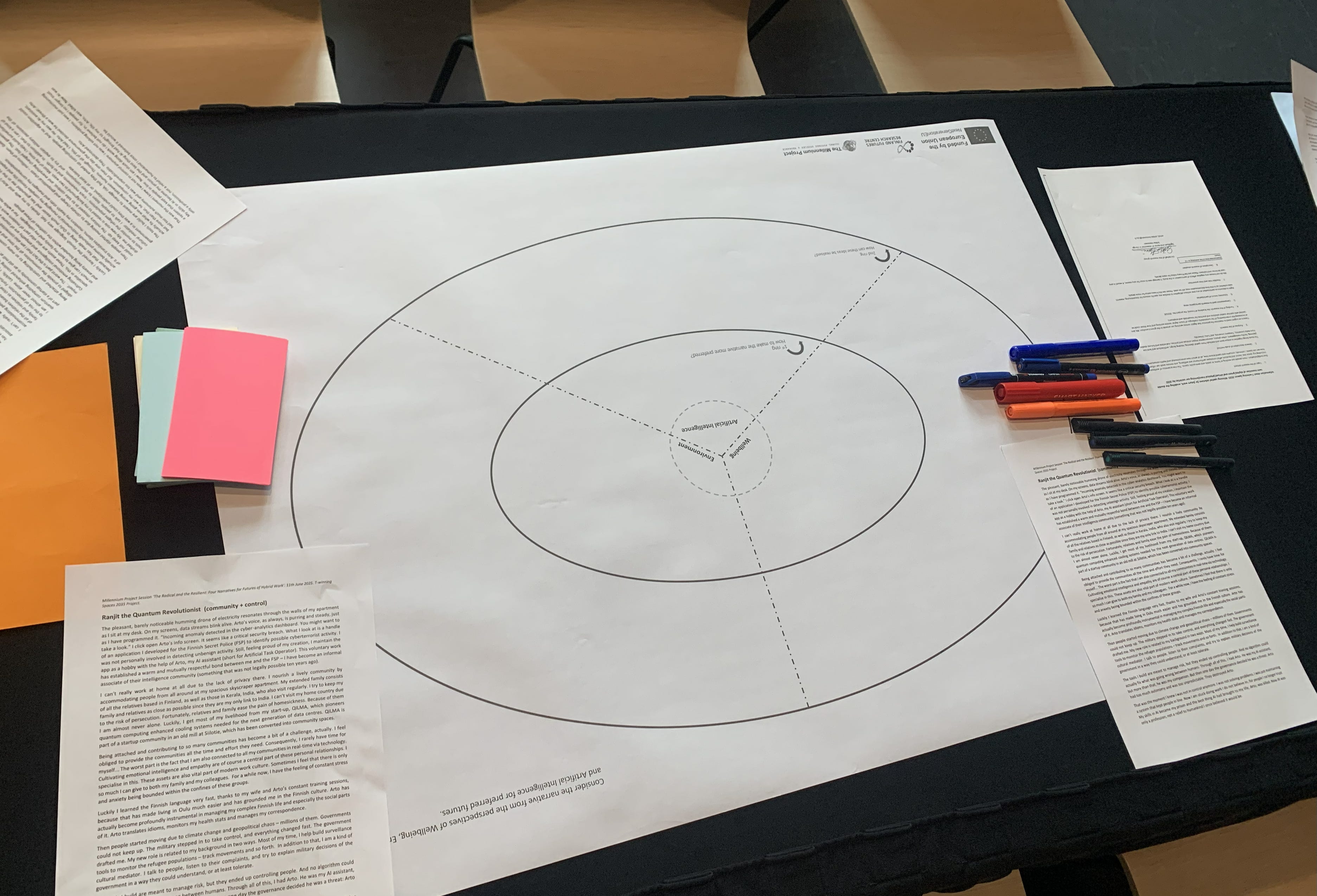
In the final phase, the groups shared their key ideas in short presentations, receiving feedback from experts. Across all seven groups, 58 participants generated 147 post-its: 55 on well-being, 50 on environment, and 42 on AI, with a balanced engagement between proposed improvements and realization strategies.
As for Edvin the Econaut, Group 1 highlighted two tensions in the narrative: motivating action through emotional engagement, especially among youth, and ensuring effectiveness via scientific rigor. AI was seen as a knowledge-generating tool, while lifestyle and culture were considered key for sustainable, experiential change. Group 5 focused on intergenerational communication, noting how Edvin had failed to connect with younger generations. The key tension highlighted the need for proactive, ongoing bridge-building among age groups. Participants proposed using AI as a “translator” to facilitate communication, share skills, and foster community, reflecting optimism that technology can help overcome generational barriers.
As for Irene the Influencer, Group 2 highlighted the blurred boundaries between work and leisure, as well as the tensions inherent in influencer culture within the narrative. Participants envisioned a future in which she combines authentic, documentary-style content with caregiving, linking personal meaning to societal impact. Group 6 focused on Irene’s dual roles as influencer and caregiver, highlighting work-life tensions, gendered expectations, and systemic care challenges. Participants proposed solutions such as time-banking, robotics, and community projects, envisioning a “caregiver influencer” who redefines freedom through care, rest, and social engagement. Group 7 examined Irene’s struggle to balance caregiving, work, and leisure, noting societal inequalities and climate-related constraints. Participants emphasized mental health, the need for free time, and proposed AI, robotics, and sustainable mobility solutions to support both care and work.
As for Doris the Dream Designer, Group 3 focused on fragile yet potential-rich work in 2035, balancing personal purpose with economic pressures. Key themes included shifting from individualism to communality, building multidimensional resilience, fostering trust, and using diverse knowledge to support solidarity and collective action.
As for Ranjit the Quantum Revolutionist, Group 4 focused on Ranjit and his AI assistant, Arto, exploring the impact of its loss on Ranjit’s well-being. Solutions included rebalancing life with more leisure and family time, and less work, alongside redesigning Arto as a less autonomous, more humanoid, and leisure-supporting assistant, highlighting tensions between technological freedom and personal well-being.
During the workshop, participants built on previous studies and engaged in co-creative discussions and visual techniques, while exploring these dynamics through futures provocations and narratives. In doing so, they experimented with the consequences of some of these potential shifts on daily life and professional practices, moving beyond conventional approaches to imagine futures of work that are resilient and desirable, while seeking to balance awareness of challenges with a positive perspective grounded in human needs and aspirations. The Futures Clinique exercise showed that narrative-based, participatory methods can help explore hybrid futures of work, engaging participants with tensions between freedom and control, individual and societal needs, and technology’s promises and risks, while also identifying practical pathways to desirable futures. The workshop highlighted the central role of self-actualisation, personal values, and community resilience, showing that future work is not only shaped by technology or systems but also by our ability to co-create meaningful, adaptive, and sustainable ways of living and working
The experiment suggests that the futures of work, shaped by emerging technologies, environmental crises, and social transformations, require us to not only imagine, but also to actively co-define, discuss, and build preferable futures, integrating values of well-being, sustainability, and ethics at every step. At the heart of this application is the understanding that no single individual or discipline can fully grasp the complexity of the socio-technical transformations ahead, nor can address them alone. By combining diverse perspectives, knowledge, and cultural insights within a systematic methodological framework, collective intelligence serves as an essential and guiding resource that enables us to identify common opportunities and develop responsible, actionable strategies. This experience reinforces the idea that foresight is not just abstract speculation, but a collective practice of responsibility and co-creation within rigorous methodology.
I hope that this work inspires readers to reflect on the value of collaboration and the importance of thinking collectively with positivity, while recognising collective intelligence as a cornerstone for the decades ahead.